Here you can check the latest news and announcements involving members of the cosmology group at IFCA. You can check contact details in the people tab.
Latest news of the IFCA Cosmology group
A Sea of Light: HETDEX Astronomers Reveal Hidden Structures in the Young Universe
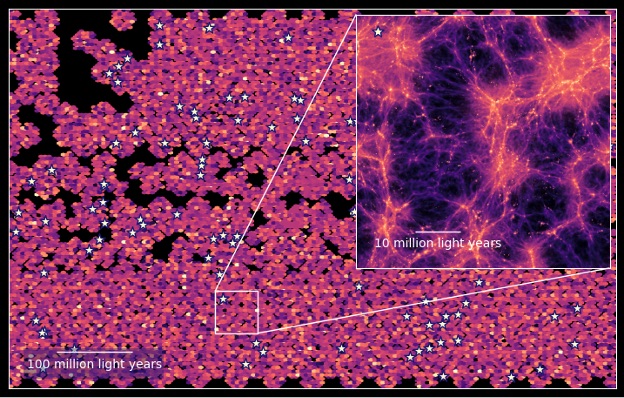 Section of the Line Intensity Map created by charting the distribution and concentration of excited hydrogen (via the Lyman alpha wavelength) in the universe ten billion years ago. The stars mark where HETDEX has found galaxies. The inset simulates the structure present in this map once it is zoomed in on and background noise is removed from the data. [Credit: Maja Lujan Niemeyer/Max Planck Institute for Astrophysics/HETDEX, Chris Byrohl/Stanford University/HETDEX]
Astronomers with the Hobbly-Eberly Telescope Dark Energy Experiment (HETDEX) have used data from the project to make the largest, most accurate 3D map yet of the Lyman-alpha emission in the early universe, 9 billion to 11 billion years ago. This work, published in the Astrophysical Journal was the first result of the Lyman-alpha line-intensity mapping survey with HETDEX, for which all of the Lyman-alpha photons were collected and quantified thanks to the cross correlation with the detected Lyman-alpha Emitters (LAEs) from the HETDEX galaxy survey. This is so far the highest-significant line-intensity mapping measurement to date, establishing the path for future measurements. At IFCA, José Luis Bernal is involved in HETDEX in the LIM survey.
You can find more information in the official press release and its adaptation to Spanish at IFCA’s webpage.
Cosmic Fireworks to Solve the Hubble Constant Tension
19 February 2026
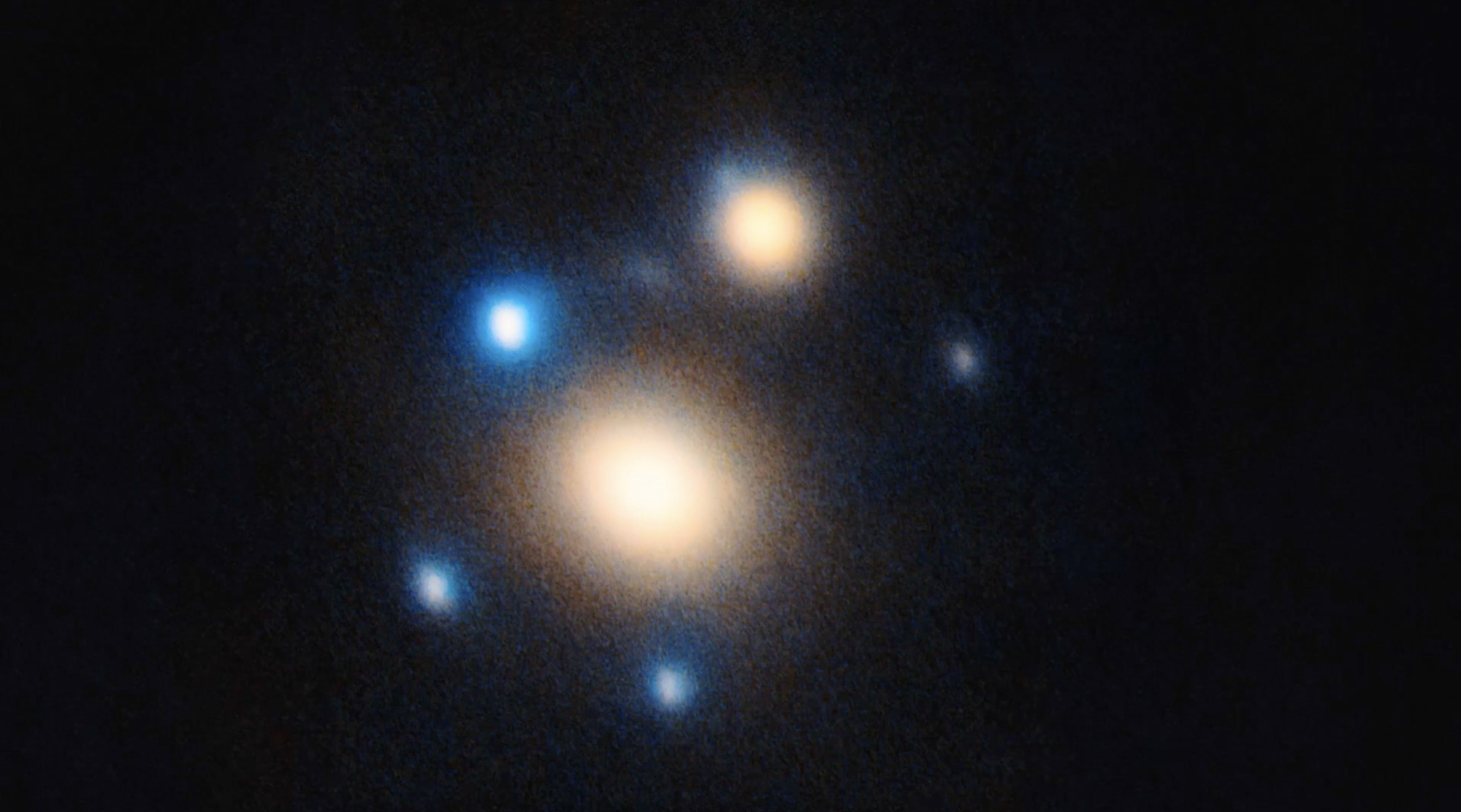 Supernova lensada por dos galaxias. SN Winny Research Group [Ecker et al. 2025]
An international research group with participation from TUM, LMU, MPA and MPE, with special involvement of Ana Acebrón (second author of the article) at IFCA, has observed a extremely bright, lensed supernova using the Large Binocular Telescope. This system will be key to determine the current expansion rate of the Universe, weighing in in the so-called Hubble constant tension. This is because the image captures 5 different images of the same supernova, due to the strong lensing caused by the galaxy in the line of sight. As light travels through 5 different paths, if a good lens model is available it is possible to precisely measure geometric combinations of the distances involved in the system to infer the value of the Hubble constant. At IFCA, Ana is measuring precise time delays between the images using the Gran Telescopio de Canarias.
You can find more information in the national newspaper El Diario.es and at the news tabs of the IFCA webpage.